Text description provided by the architects
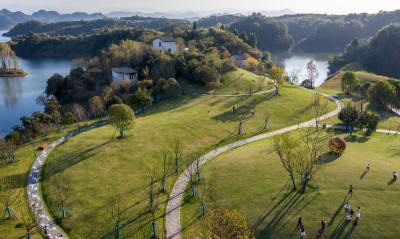
The Luhu Island dry-ski slope sits on Luhu Island in the center of the 2,400-plus-mu Luhu Water City scenic area in Chengdu, where custom-designed experimental landscapes and buildings have become special sights on the island. Commissioned by the Luhu developer, the project places a 20-meter-wide beginner slope and a 30-meter-wide intermediate slope on a natural lake-facing terrain to meet skiers' practice needs. The site is narrow: surrounded by already-built land, with little effective depth between the block and the lake and a gentle on-site gradient, it could not meet the required slope length and angle. Piling earth alone would have demanded large earthwork and pressured the neighbors; after repeated discussion with the client and technical team, the designers chose a local earth-berm combined with light scaffolding, which affects surrounding land less and is easier to build, to deliver the required slope length and angle. The first rest platform uses container architecture as pre-entry preparation, while the second platform and building house the beginner takeoff, a passage to the intermediate takeoff, waiting areas, a parents' lounge and storage. Because the site is lakeside, the ski slopes run perpendicular to the shoreline, making the headlong rush toward the lake the core experience. Two lanes share one prep area: the beginner lane drops directly so children in ski boots do not walk far, while the intermediate lane is reached by scaffolded platforms rising to a 15-meter elevation above the lake for faster runs. A misting system on the slope surface keeps it damp, reducing friction and improving speed. Within a reasonable budget, the landscape team tried various slope treatments before settling on linear guidance plus graded terraces, set off by bold color blocks and lines that blend structure with site and raise legibility through pure color contrast. The entry welcomes visitors in an open form: a strongly colored linear ramp and brightly colored retaining walls lead from the vehicular road into the site, where dark-gray paving with bright-yellow lines adds movement and guidance. Open boundaries invite interaction, giving spectators good stopping points, and reserved lawns offer future event space.


 Editor's Pick